

Why new wine bottles need rinsing before filling
New glass is not clean glass. Between the moulding line and your bottling hall, a bottle can spend weeks in a shipping container, cross an ocean, sit in a warehouse and travel by truck open end up, on a pallet, under shrink wrap.
What ocean freight and storage can leave behind
- Glass fines and mould release residue left from manufacturing, loosened by vibration in transit
- Cardboard and pallet dust shed by the packaging itself over hundreds of kilometres
- Condensation from temperature swings between a container hold and your cellar, which carries airborne particles down into the bottle
- Some odour transfer from adjacent cargo, treated pallets or the container lining, a bottle that smells of cardboard or diesel will pass that character straight into the wine
- Insects and organic debris in bottles stored in an open or semi-open warehouse
None of this is visible when you look down the neck of a bottle. It becomes visible in the glass, months later, as haze, sediment or a fault in the aroma.
Why returned and reused bottles need rinsing
Returnable bottle programmes are growing fast, and for good reason: reusing a bottle avoids the carbon cost of making a new one. But a returned bottle carries a different and higher risk than a new one.
Bottles collected by a third-party service provider are pooled, transported and stored before they come back to you. Along the way they may pick up residual wine, cork or capsule fragments, label adhesive, cleaning agent from an earlier wash, or simply the smell of the crate they travelled in. A single contaminated bottle in a batch can spoil a customer’s experience and, in the worst case, trigger a recall.
If you run a returnable programme, rinsing is not an optimisation – it is the control point that makes the programme safe.
What contamination costs a winery
The cost of a contaminated bottle is never just the bottle. It is the wine inside it, the labour to fill and label it, the freight to ship it, and the relationship with the customer who opens it.
For a producer running a returnable programme or importing glass, a rinse step is among the least expensive forms of insurance available.
How the Aquatech-BM rinse cycle works
Our machines are built for washing and sterilising, but they also run a short single-pass rinse cycle designed specifically for this case: bottles that are structurally clean but need contamination removed before filling.
- One pass, one step. No pre-soak, no chemical stage, the bottle enters, is rinsed inside and out, and leaves ready to fill.
- Hot rinse above 88 °C (190 °F) when the format and the risk call for it.
- 100 to 1,200 containers per hour depending on bottle format and cycle length.
- Containers from 5 mL (0.17 fl oz) to 60 liters, (15.851 gal) with custom manifolds and basket trays made to fit your own bottles.
- 304 and 316L stainless steel construction, designed for a 10 to 20 year service life.
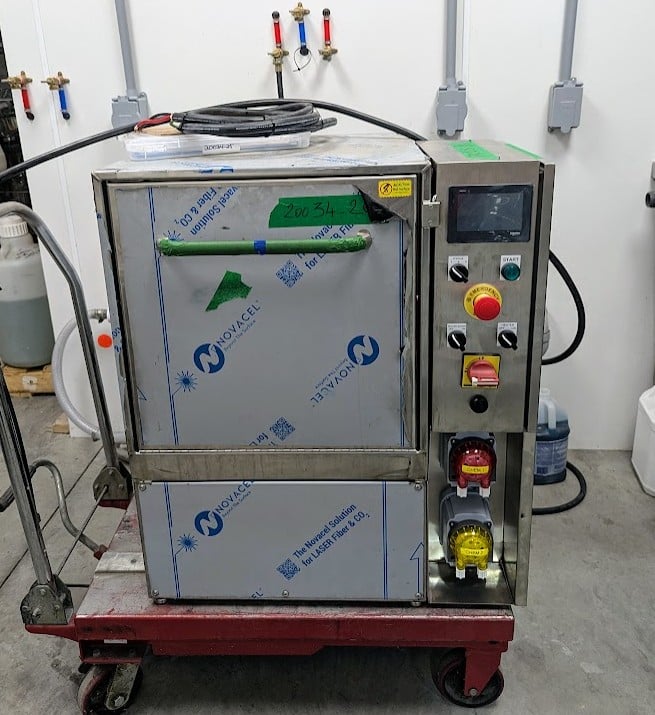
The rinse cycle runs on both the Multi-Function Bottle Washer and the Multi Compact Washer with the manifold and basket tray matched to your bottle format.
Configuring the cycle on the HMI touch screen
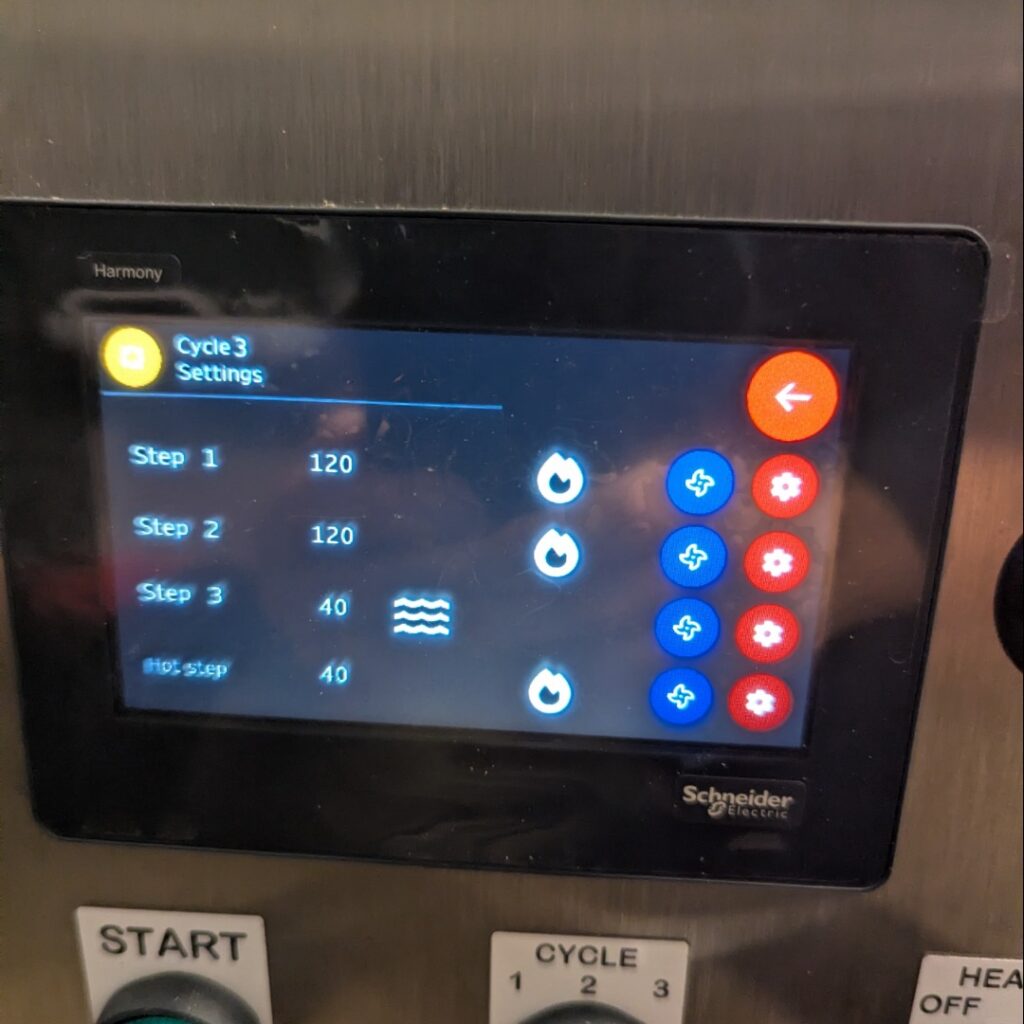
The optional Schneider Harmony touch screen lets you set the cycle yourself, without a service call: rinse duration, water temperature, dosing and alarms are all adjustable on the panel, and daily wash totals are logged.
You can keep one short programme for new glass and a second, longer one for returned bottles, and switch between them at the screen.
Frequently asked questions
Do new wine bottles really need rinsing? Yes, in most cases. New glass leaves the factory clean, but ocean freight, warehouse storage and pallet transport reintroduce dust, glass fines and odour before the bottle reaches the filler.
How long does a rinse cycle take? The short single-pass cycle is designed for speed, and the duration is adjustable on the HMI. Throughput ranges from 100 to 1,200 containers per hour depending on format.
Can the same machine wash returned bottles? Yes. The same equipment runs a longer wash and sterilise cycle with a hot rinse above 88 °C for returnable programmes. You can store both programmes and switch between them.
How much water does a rinse cycle use? Considerably less than manual rinsing, and the cycle is adjustable so you use only what the format requires.
Where are the machines built? In Boucherville, Quebec. Designed and manufactured in Canada, we start from the stainless steel sheet and do the fiber laser cutting, the bending the welding, the assembly, the control panel, the programming all in hour, inspected to CSA SPE-1000 and CE marked, with delivery worldwide, in more than 90 country.
Which model fits your bottling line
| Your situation | Recommended approach |
|---|---|
| New bottles, straight from pallet to filler | Short rinse cycle, ambient or warm water |
| Returned bottles from a collection programme | Full wash and sterilise cycle, hot rinse above 88 °C |
| Mixed formats on the same line | Custom manifolds and basket trays, cycle presets on the HMI |
Tell us what you bottle and how many bottles per hour, and we will recommend the model and the manifold set that fit.
If you bottle wine exclusively, our Winemaker wine bottle washer for wineries page covers the full washing and sterilizing cycle, not just the rinse step.